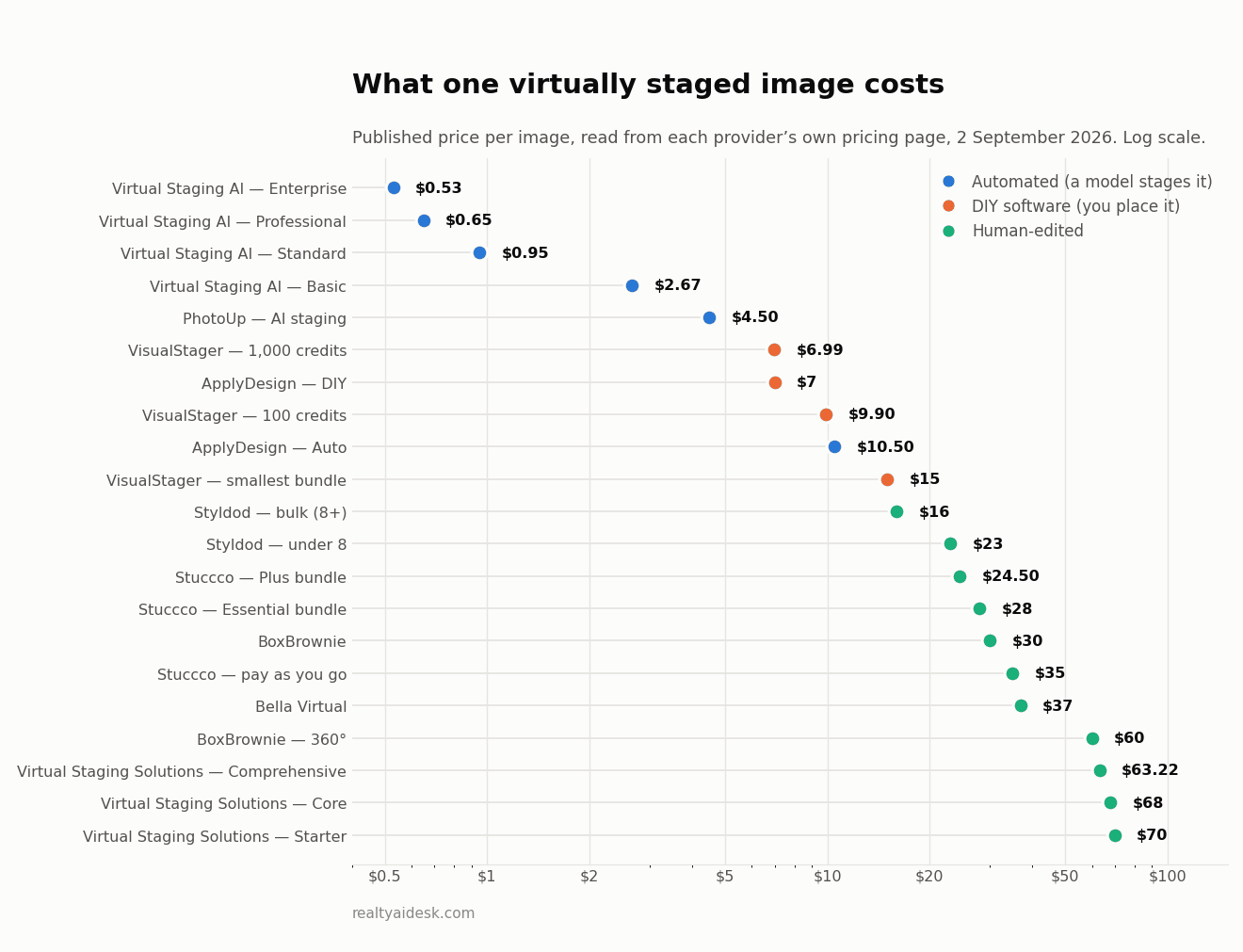
Updated 2 September 2026. Every price on this page was read from the provider’s own pricing page on that date. This table is re-checked monthly, and the date above moves only when the check actually happens.
Almost every page about virtual staging cost is written by a company that sells virtual staging. The number they quote is the number that makes their plan look good, and the comparison they draw is with whichever competitor they beat.
So here are the actual prices, taken from the providers’ own pricing pages, alongside what physical staging costs for the same house. Then the part nobody puts in the table: the four things that make the real bill different from the sticker price.
The real numbers
Three different products are sold under the name “virtual staging”, and mixing them in one list is what makes every other price comparison useless. They are separated here.
Automated: a model stages the photo
| Service | Published price | Per image | Notes |
|---|---|---|---|
| Virtual Staging AI — Basic | $16/month, 6 photos | $2.67 | Monthly plan, not credits you keep |
| Virtual Staging AI — Standard | $19/month, 20 photos | $0.95 | |
| Virtual Staging AI — Professional | $39/month, 60 photos | $0.65 | |
| Virtual Staging AI — Enterprise | $79/month, 150 photos | $0.53 | Cheapest published price anywhere |
| PhotoUp — AI virtual staging | 3 credits per image, credits from $1.50 | from $4.50 | 24-hour standard delivery, unlimited revisions |
| ApplyDesign — Auto Staging | 1.5 coins per image, coins $7 to $10 | $10.50 to $15 | 15-minute turnaround |
DIY software: you place the furniture
| Service | Published price | Per image | Notes |
|---|---|---|---|
| VisualStager — smallest bundle | $15 for 10 credits | $15.00 | 10 credits per standard photo, 15 per 360° |
| VisualStager — 100 credits | $99 | $9.90 | Credits never expire |
| VisualStager — 1,000 credits | $699 | $6.99 | Cheapest tier |
| ApplyDesign — DIY Staging | 1 coin per image, coins $7 to $10 | $7 to $10 | Drag-and-drop editor |
One detail worth knowing before you buy DIY: VisualStager adds a watermark that discloses the image is virtually staged, and removing it costs an extra credit or a monthly reseller plan from $10. That is a real cost, and the disclosure it makes is one you are required to make anyway.
Human-edited: a person stages the photo
| Service | Published price | Per image | Notes |
|---|---|---|---|
| Styldod — bulk (8+ images) | $16 per image | $16.00 | 24–48 hours, unlimited free revisions |
| Styldod — under 8 images | $23 per image | $23.00 | Rush: +$6 for 24h, +$12 for 12h |
| Stuccco — Plus bundle | $799 prepaid | $24.50 | 24-hour turnaround, seven days a week |
| Stuccco — Essential bundle | $399 prepaid | $28.00 | Unlimited revisions, no extra fees |
| BoxBrownie | $30 per image | $30.00 | 48 hours, unlimited changes for two months, no subscription |
| Stuccco — pay as you go | $35 per image | $35.00 | No prepayment |
| Bella Virtual | from $37 per image | from $37.00 | 24–48 hours |
| BoxBrownie — 360° | $60 per image | $60.00 | For virtual tours |
| Virtual Staging Solutions — Comprehensive | $569 for up to 9 photos | $63.22 | Priced per property, 1,500–2,500 sq ft |
| Virtual Staging Solutions — Core | $408 for up to 6 photos | $68.00 | Free revisions, money-back guarantee |
| Virtual Staging Solutions — Starter | $210 for up to 3 photos | $70.00 | Most expensive per image on this page |
The extras nobody puts in the headline price
- Removing existing furniture is almost always billed separately from adding it. VisualStager prices it by how full the room is: 8 credits for one or two items, 12 lightly furnished, 16 light-to-medium, 20 for a cluttered room, and it declines fully furnished rooms outright.
- Changing paint or flooring is its own line. Stuccco publishes it at $19.00 pay as you go, dropping to $13.30 on the Plus bundle.
- Basic photo enhancement — exposure, straightening, sky — runs $3.00 at Stuccco pay as you go, $2.10 on the bundle.
- Rush delivery. Styldod is the only one publishing it plainly: +$6 per image for 24 hours, +$12 for 12 hours. On a $16 bulk image that is a 75% premium.
- 360° images cost roughly double a flat photo everywhere they are offered.
- The rights. Not a line on any invoice, but worth checking before you order: who owns the staged image differs between an automated tool and a human editor.
From $0.53 to $70 per image. That is a spread of more than a hundred times, and it is not marketing fluff. It is three different products wearing the same name — and the names themselves are a mess too.
What the gap actually buys
At the bottom of the range, a model generates furniture into your photo in seconds. Nobody looks at it. When it works, it is remarkable value. When it fails, it fails in specific ways: furniture floating slightly off the floor, a sofa passing through a radiator, shadows falling in a direction the window does not allow, a rug that bends where the floor does not.
At the top of the range, a person edits the image and another person checks it. BoxBrownie’s own listing includes unlimited changes for two months at no extra cost, which tells you what you are really paying for: not the furniture, the fixing.
The practical rule most agents land on after a few jobs: automated for the rooms nobody scrutinizes, human-edited for the hero shot that leads the listing. A buyer scrolls past the third bedroom. They stop on the living room.
Against physical staging, for the same house
This is the comparison that decides most listings, and it is not close.
| Physical staging | Cost |
|---|---|
| National average | $1,849 |
| Typical range | $832 to $2,917 |
| Per staged room, per month | $300 to $700 |
| Vacant home | $4,000 to $6,000 |
| Initial consultation | $150 to $600 |
Now put the two side by side on a real job. Six rooms photographed for a listing, though most houses do not need six:
- Automated virtual staging: under $20, once.
- Human-edited virtual staging: $96 to $180, once.
- Physical staging: $1,849 on average, and that is the starting point rather than the total.
The word that matters in the physical column is monthly. Furniture rental is charged per room per month, so a house that sits for ninety days costs three times a house that sells in thirty. Virtual staging is charged once and does not care how long the listing runs. On a slow listing the gap does not stay at 10x — it widens every month.
Which of the two actually helps you sell, rather than which is cheaper, is a different question and it is worked through in the piece comparing virtual staging and physical staging.
The four things missing from every price table
1. Revisions
The first version is rarely the one you use. Sometimes the furniture style is wrong for the house, sometimes the seller hates it, sometimes a chair sits where a door opens. Styldod includes unlimited free revisions and BoxBrownie includes unlimited changes for two months. Check this before you buy, because a service charging per revision on a $16 image can quietly double the price.
2. Speed surcharges
Standard turnaround is 24 to 48 hours across the human-edited services. Styldod publishes the cost of jumping the queue: +$6 per image for 24 hours, +$12 per image for 12 hours. That is a 75% premium on a bulk image, and you will want it on the Friday afternoon when photos came back late and the listing goes live Monday.
3. The subscription you forget
The cheap per-image prices are monthly plans, not credits you keep. $39 a month for 60 photos is genuinely cheap if you stage 60 photos a month. If you list two houses a quarter, you are paying $468 a year for a handful of images, and the effective price per image is worse than the human service you dismissed as expensive.
Work out your real volume before choosing a plan, and if you are not sure, start with pay-per-image and no subscription. The same trap applies across the whole toolkit, which is covered in the piece on what AI tools actually cost an agent.
4. Photography you still have to pay for
Virtual staging is applied to a photograph. It does not replace the photographer, and it works badly on bad input: a dark room, a wide-angle lens bending the walls, a shot taken at an angle that makes the floor plane hard to read. Budget for the photos separately, and expect a re-shoot if the rooms were shot poorly.
How to order it so you only pay once
Most of the money agents waste on virtual staging goes on second attempts, and second attempts are almost always caused by a vague brief. Four minutes of specifics at the order stage is the cheapest saving available.
- Name the buyer, not the style. “Mid-century modern” means five different things to five different editors. “Young professional couple, first home, budget conscious” produces furniture that fits the price point, which matters more than the style label.
- Say what the room is. An editor looking at an empty square cannot tell a dining room from an office. Getting a desk where the seller wanted a table is a wasted revision, and it is your fault, not theirs.
- Flag the fixed features. Where the door swings, which wall has the outlet, where the TV point is. Furniture placed across a doorway is the single most common thing that comes back wrong.
- Send the best version of the photo. Full resolution, straight on, curtains open, lights on. Sending a compressed copy from your phone gallery and then complaining about quality is a round trip nobody needs.
- Order the whole house at once. Styldod’s bulk price starts at eight images, and it is $7 per image cheaper than ordering fewer. Six rooms ordered one at a time as you think of them costs more than the same six ordered together.
One more thing worth deciding up front: keep the unstaged originals. You will need them for the disclosure, some MLSs require the empty version to be available, and a buyer’s agent asking what the room really looks like is a reasonable request you want to answer in ten seconds.
Who actually pays
Worth settling before you order rather than after. Three arrangements exist, and all three are normal.
| Arrangement | When it makes sense |
|---|---|
| Agent absorbs it | At $20 to $180 a listing it is a small marketing cost, and it is one less conversation |
| Seller pays | Vacant homes, or where the seller wants a specific style |
| Included in your listing package | Strong at the appointment, because it sounds like something instead of an invoice |
If you use it as a selling point at the listing presentation, say the number. “Virtual staging on every room, included” lands harder than “professional marketing”, and it is the kind of specific claim that separates you from the agent who arrived with a deck. There are prompts for that whole conversation in the piece on the listing presentation.
The cost that is not money
Cheap staging that is not disclosed is the most expensive version of all. Many MLSs require staged images to be labeled, and a buyer who drives to a house expecting furniture they saw online is a complaint waiting to happen. The disclosure rules, and what you can and cannot alter in an image, are set out in the piece on whether virtual staging is legal.
Adding furniture is generally fine. Removing a crack, a stain or a power line is not staging, it is misrepresentation, and no price per image covers what that costs you.
Common questions
What should I budget for a normal listing?
For five or six rooms with a human-edited service, $80 to $180. Automated, under $20. If someone quotes you several hundred dollars for a standard house, ask exactly what is different, because the published prices above are what the main providers charge.
Is the cheap automated version good enough?
Often, for secondary rooms. Look hard at the floor line where furniture meets the ground and at the direction of the shadows — that is where the automated versions give themselves away. If it passes on a phone screen at arm’s length, it will pass on a portal.
Is it cheaper to do it myself in a design tool?
Cheaper in money, expensive in time, and the results usually show it. Design tools are strong for listing graphics and social posts rather than for putting furniture into a room photograph, which is a different job — the piece on Canva’s AI features covers where that line falls.
Does virtual staging cost more for a vacant house?
No, and that is exactly where it wins hardest. Physical staging of a vacant home runs $4,000 to $6,000 because everything has to be brought in. The virtual price per image does not change at all — an empty room is arguably easier to stage than one you have to digitally clear first.
Sources
- Virtual Staging AI, published subscription plans and monthly photo allowances.
- Styldod, published per-image pricing, turnaround times and expedited delivery surcharges.
- BoxBrownie, published per-image pricing, turnaround and revision policy.
- Angi, 2026 cost data for physical home staging: national average, ranges and per-room monthly rental.
Checked September 2026. Prices change; confirm on the provider’s own pricing page before you commit to a plan.